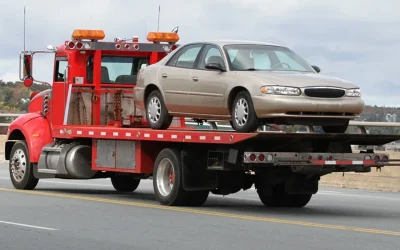
Towing transports a disabled vehicle from one location to another, while recovery first moves a vehicle from a ditch, sand, mud, slope, or other difficult position. When a vehicle leaves the pavement near Apache Junction, AZ, the situation may require recovery before a towing service can safely transport it.
Understanding this distinction helps drivers describe the problem accurately, avoid making the situation worse, and request the right type of roadside assistance.
What Is the Main Difference Between Towing and Recovery?
Standard towing generally applies when a vehicle is accessible and positioned on a stable surface. The car, motorcycle, van, or recreational vehicle may have a mechanical failure, flat tire, dead battery, or another problem that prevents it from being driven safely.
A towing company can then load or connect the vehicle and transport it to a repair facility, home, or another appropriate destination.
Recovery is different because the vehicle cannot be immediately accessed or moved through ordinary towing procedures. It may be stuck in loose desert soil, resting below the roadway, positioned at an angle, or surrounded by obstacles.
The recovery process focuses on bringing the vehicle back to a stable and accessible location. Once that step is complete, towing may still be needed if the vehicle has damage or cannot operate safely.
Why Do Vehicles Leave the Pavement Near Apache Junction?
Road conditions around Apache Junction can change quickly. Loose gravel, sandy shoulders, uneven desert roads, narrow access areas, and reduced nighttime visibility may contribute to vehicles leaving a stable driving surface.
A driver may pull onto a soft shoulder to avoid traffic, only to have the tires sink into loose soil. A vehicle can also slide during wet weather when dirt roads and shoulders become muddy or unstable.
Other situations may involve:
- Missing a turn on an unfamiliar road
- Driving too close to the edge of a shoulder
- Losing traction on loose gravel
- Entering a trail or unpaved area unsuitable for the vehicle
- Moving aside for another vehicle where the ground is soft
- Encountering erosion after heavy rain
Even when the vehicle appears undamaged, its position may make ordinary towing unsafe until it is recovered.
What Should Drivers Do After Leaving the Roadway?
The first step is to stop attempting to move the vehicle if the tires are spinning or the vehicle is shifting into a worse position. Repeated acceleration can dig the tires deeper into sand, mud, or loose dirt.
Drivers should turn on their hazard lights when possible and check whether remaining inside the vehicle is safe. If the vehicle is near moving traffic, on an unstable slope, or in another hazardous position, occupants may need to move to a safer location.
However, drivers should not stand between the vehicle and the roadway or remain close to areas where another car could lose control.
It is also important to avoid crawling beneath the vehicle, placing objects near the tires, or attempting to pull the vehicle with an unsuitable strap or another passenger vehicle. These actions may damage the vehicle or cause injuries.
What Information Does a Towing Company Need?
Accurate information helps the towing company understand whether the situation involves routine towing, recovery, or both.
Drivers should provide:
- Their exact location or a shared map pin
- Nearby roads, trail entrances, landmarks, or mile markers
- The vehicle’s type and approximate size
- Whether the vehicle is on sand, mud, gravel, or a slope
- The position of the vehicle relative to the roadway
- Any visible damage to the tires, wheels, steering, or body
- Whether the vehicle can start, shift, steer, or roll
- Any nearby obstacles or restricted access points
Photos may also help show the vehicle’s position and surrounding terrain when they can be taken without entering an unsafe area.
Can Roadside Assistance Resolve the Problem Without Towing?
Roadside assistance may be enough when the vehicle remains on a stable surface and has a simple issue such as a discharged battery, flat tire, low fuel level, or lockout.
Once a vehicle leaves the pavement, however, the question is no longer limited to whether the engine runs. The vehicle must also be safely returned to a stable surface.
After recovery, the driver should assess whether the vehicle can be operated safely. A damaged tire, bent wheel, fluid leak, steering problem, unusual vibration, or warning light may indicate that towing is still necessary.
Driving immediately after a recovery attempt can make hidden damage worse. When there is uncertainty, transporting the vehicle for inspection is generally safer than testing it on an active roadway.
When Should Emergency Services Be Contacted?
Drivers should call emergency services when anyone is injured, the vehicle is blocking traffic, there is smoke or fire, fuel is leaking, or the vehicle is in danger of rolling.
Emergency responders may also be necessary when the vehicle enters floodwater or stops in a location that creates an immediate hazard for other motorists.
Vehicle recovery should wait until urgent safety concerns are addressed. Drivers should clearly explain the location, number of occupants, vehicle position, and any injuries or hazards.
How Can Drivers Reduce the Risk of Getting Stuck?
Drivers can lower the risk by staying on established roads, avoiding soft shoulders, and checking road conditions before entering unpaved areas. Reducing speed also provides more time to react to loose gravel, sharp turns, washouts, and changing terrain.
Vehicles designed for regular pavement travel may not have the clearance or traction needed for desert trails. Turning around early is often safer than continuing into an area where the road becomes narrow, sandy, or uneven.
It is also helpful to keep a charged phone, drinking water, flashlight, and location-sharing capability available when traveling outside developed areas near Apache Junction.
Stranded Beyond the Pavement? Get the Right Help
When a vehicle is stuck in sand, mud, gravel, or uneven terrain, avoid repeated acceleration and unsafe self-recovery attempts. Contact a local Towing Service that can evaluate the vehicle’s position and determine whether recovery, transport, or roadside assistance is appropriate. Share accurate location details, vehicle information, visible damage, and nearby hazards so help can arrive properly prepared.