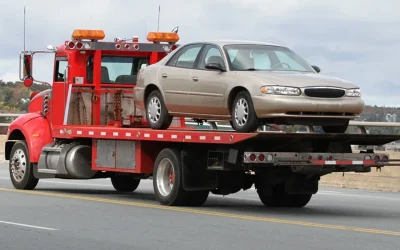
A vehicle becomes high-centered when its undercarriage rests on raised ground or an obstacle while one or more tires lose firm contact with the driving surface. Because the tires cannot produce enough traction, pressing the accelerator usually will not move the vehicle and may make the situation more difficult.
High-centering can happen on desert trails, uneven dirt roads, washed-out shoulders, construction areas, parking barriers, and rocky terrain. Drivers in Apache Junction, AZ, may encounter these conditions when traveling beyond maintained pavement or navigating roads affected by erosion.
How Does a Vehicle Become High-Centered?
A vehicle needs enough ground clearance to pass over rocks, ridges, berms, and changes in road elevation. When the center of the undercarriage contacts an obstacle before the tires reach stable ground, part of the vehicle’s weight transfers away from the wheels.
The vehicle may appear level, tilted to one side, or balanced across a ridge. In each situation, the tires have less weight pressing them against the surface. This loss of contact reduces traction, even if the engine and drivetrain are operating normally.
High-centering is more likely when a vehicle crosses a raised area at the wrong angle or enters a rut that is deeper than expected. Loose soil can also shift beneath the tires, allowing the vehicle to settle until its frame, axle, differential, or protective panels touch the ground.
What Are the Signs That a Vehicle Is High-Centered?
The clearest sign is that the tires rotate while the vehicle remains in place. A driver may also notice that one or more wheels appear suspended, lightly touching the ground, or sitting lower inside a rut.
Other indicators can include:
- Scraping or pressure beneath the center of the vehicle
- Limited tire contact with the ground
- A vehicle resting on a rock, ridge, or berm
- Wheels spinning without forward or backward movement
- The vehicle rocking without gaining traction
- Visible contact between the undercarriage and terrain
Drivers should stop applying power when these signs appear. Continued wheel movement can remove loose material from beneath the tires, deepen surrounding ruts, or shift the vehicle into a less stable position.
Why Can Pressing the Accelerator Make It Worse?
Acceleration is effective only when the tires have enough contact with a stable surface. When a vehicle is high-centered, additional throttle may spin the wheels without generating useful movement.
Spinning tires can scatter gravel, dig into soil, and create deeper pockets around the wheels. The vehicle may settle farther onto the obstacle as material is displaced. Sudden traction can also cause the vehicle to lurch in an unexpected direction, particularly on a slope or narrow trail.
Repeated attempts may increase heat in the transmission or drivetrain. They can also expose tires, suspension parts, and underbody components to additional stress. Recognizing that the vehicle is physically supported by the terrain—not simply experiencing poor traction—is an important distinction.
Is High-Centering the Same as Being Stuck in Sand?
The two situations can occur together, but they are not identical. A vehicle stuck in sand may still have its full weight on all four tires. Its main problem is that the surface cannot provide enough traction.
A high-centered vehicle has part of its weight resting on the undercarriage or another component. Even if a firm surface is placed beneath the tires, the vehicle may remain stuck because the wheels do not carry enough weight to move it.
This difference affects the recovery approach. Traction-focused measures may help a vehicle sitting fully on its tires, while a high-centered vehicle often requires controlled movement that reduces pressure on the contact point and restores weight to the wheels.
What Parts of the Vehicle May Be at Risk?
The component touching the terrain depends on the vehicle’s design and the shape of the obstacle. Contact may involve protective panels, crossmembers, suspension parts, exhaust components, an axle, or the differential housing.
Drivers should avoid crawling beneath a stranded vehicle to inspect it. Unstable soil or a change in weight distribution can cause the vehicle to shift without warning. A visual inspection should only be performed from a safe position around the vehicle.
After recovery, the vehicle should be checked for fluid leaks, unusual noises, warning lights, steering changes, or visible underbody damage. If there is any concern about safe operation, transportation to an appropriate repair facility may be the safer option.
What Information Helps During a Recovery Request?
Accurate information helps a towing company understand the vehicle’s position and surrounding access. The driver should share the vehicle type, approximate location, road or trail conditions, visible obstacles, and whether any wheels are off the ground.
Photos taken from a safe distance may help show the terrain and vehicle angle. A dropped map pin can also be useful when the location does not have a street address. Drivers should mention nearby gates, narrow access points, steep grades, soft shoulders, or overhead limitations.
When searching for a Towing Service, drivers should explain that the vehicle may be high-centered rather than describing it only as stuck. That detail helps distinguish a recovery situation from ordinary roadside assistance.
How Should Drivers Stay Safe While Waiting?
The first priority is protecting passengers and avoiding additional vehicle movement. Turn off the engine if continued operation is unnecessary, apply the parking brake when appropriate, and keep people away from slopes or unstable ground.
If the vehicle is near active traffic, use hazard lights and remain in a protected location. A 24/7 towing service may be needed when the incident occurs after dark, but drivers should avoid walking along an unfamiliar road or trail to search for help.
High-centering is a terrain and weight-distribution problem that requires careful assessment. If a vehicle becomes supported by its undercarriage in Apache Junction, stop repeated attempts to move it and contact a towing company that handles vehicle recovery. Provide an accurate location and a clear description of the terrain so the situation can be evaluated safely.